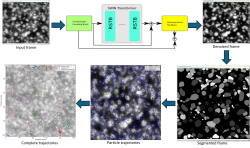
We leverage state-of-the-art machine learning and deep learning techniques in electron microscopy, with a specific focus on scanning transmission electron microscopy (STEM) data. Electron microscopy provides unprecedented insights into materials at the atomic and nanoscale; however, the increasing complexity and volume of modern datasets demand automated, data-driven solutions for efficient interpretation and discovery of salient features. Our goals are to
enable automated detection of material defects and lattice perturbations
deploy structure and phase segmentation, supporting quantitative analysis of complex nanostructures
generate synthetic images and augment data, addressing limited training data availability and improving model generalization
track atomic motions in time-resolved electron microscopy to uncover how matter assembles at the atomic level
reduce noise and enhance low-dose imaging, facilitating experiments with high signal-to-noise ratio while minimizing beam damage in sensitive samples
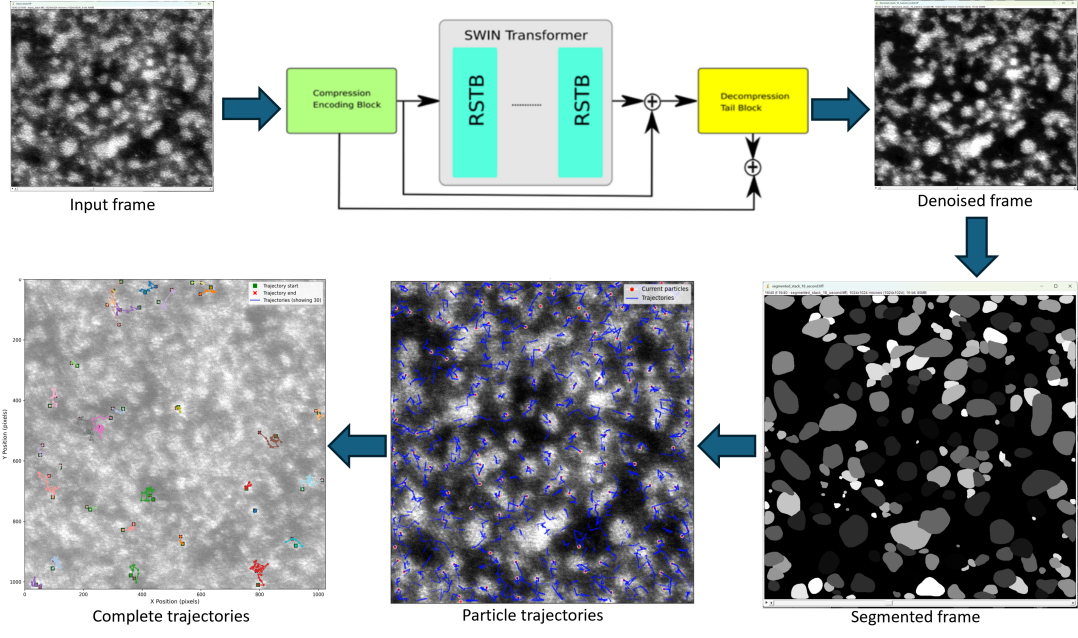
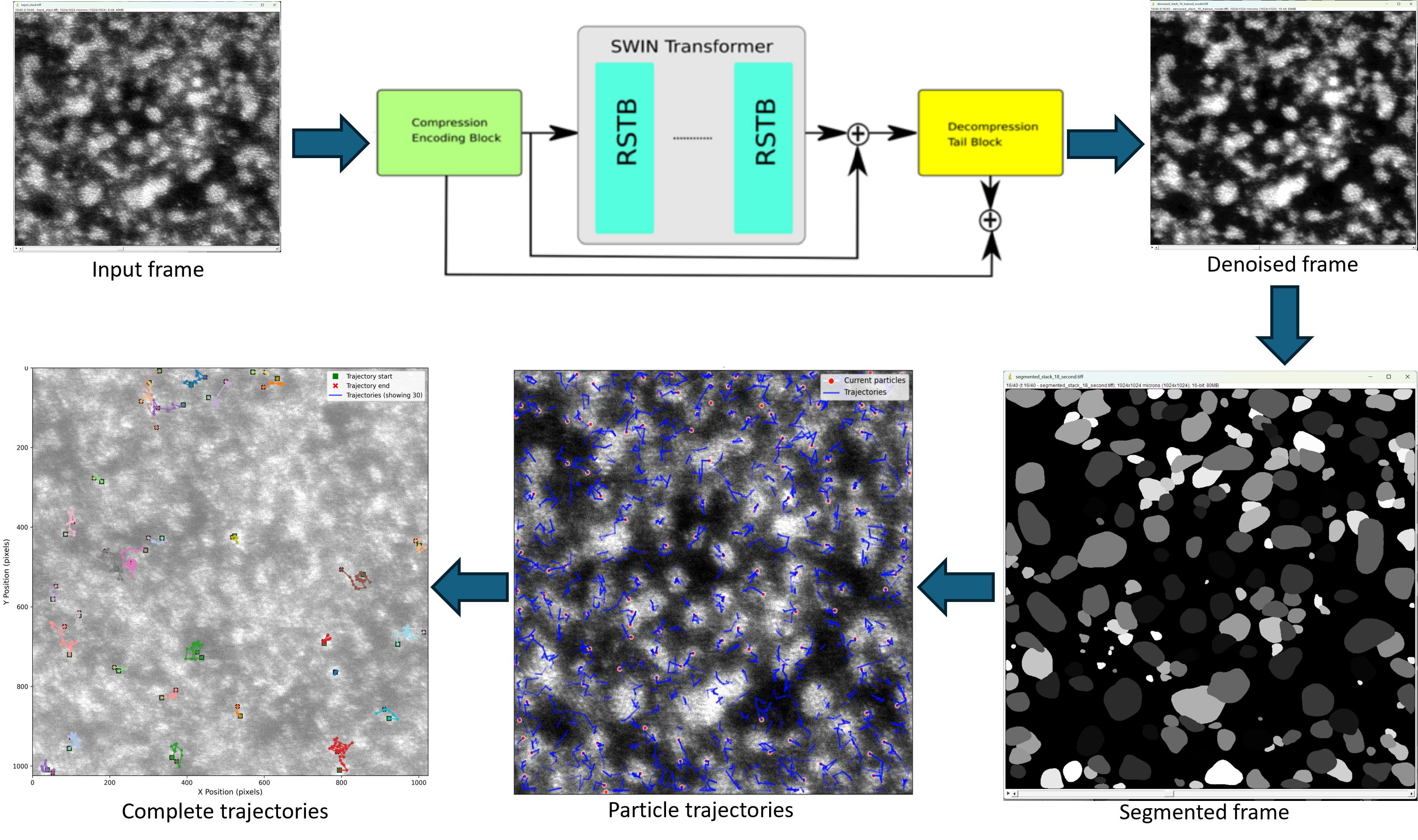
A major emphasis of our work is the development of robust deep learning pipelines for automated workflows integrating steps such as denoising, segmentation, object linking and trajectory prediction. These approaches enable quantitative measurements of dynamic material behavior at the nanoscale and open new opportunities for real-time interpretation of in situ electron microscopy experiments.
Looking forward, an important extension of this work will involve the development of semi-supervised and unsupervised learning approaches to overcome challenges associated with scarce labeled data and the high cost of expert annotation in electron microscopy. By incorporating these advanced learning paradigms, we seek to broaden the impact and scalability of artificial intelligence-driven methods in microscopy.

Copyright © ATEM 2026
Last update: Feb 24, 2026